emaginings: Had To Write Today
May 17, 2013 by Linda McLaughlin in category The Romance Journey by Linda Mclaughlin tagged as emaginings, Linda McLaughlin, writingAs usual, I had trouble coming up with a topic for today’s blog. You’d think I could plan ahead, but no. Couldn’t think of anything yesterday so I procrastinated. Then today it hit me. I HAD TO WRITE!
I’ve launched two reissues in the last couple of months, ROGUE’S HOSTAGE and LADY ELINOR’S ESCAPE. There’s a lot of work involved in self-publishing, revisions, edits, cover art, etc. And more work involved in a book launch. It seems like all I’ve been writing lately is blog posts and I just couldn’t stand it any more. Today I had to write.
I’ve been half-heartedly working on two projects, trying to fit them in in between blogs and tweets and what not. One is a sexy novella as Lyndi Lamont, and the other is a Western historical romance set after the Civil War that I started and abandoned years ago when conventional wisdom said Westerns wouldn’t sell. That’s no longer true, if it ever was, so…
Today I delved back into the Western, and it felt good to get reacquainted with my characters. I’m doing some revisions, but the story seems sound, at least so far. The main thing was, it felt good to write again, even if it is just revising. Promo can suck up so much time, esp. when you don’t have a big publishing house behind you. It’s easy to get caught up in the minutiae and forget to write.
So my apologies for this rambling, possibly incoherent blog post. But you see, I had to write today.
Linda McLaughlin
1 0 Read moreMissing a Meeting
April 6, 2013 by Linda O. Johnston in category Pets, Romance & Lots of Suspense by Linda O. Johnston tagged as Family, Killer Hobbies, Linda O. Johnston, writing
I unfortunately won’t be at the upcoming OCC meeting. It sounds wonderful, but I’ll have family in town. And family comes first! Especially since the visitors will include my little grandson, who’s ten months old. He, and my son and d-i-l, live in Chicago.
I saw them just over a week ago, too, on a Florida trip that I blogged about in my weekly Killer Hobbies blog. Great trip, one on which I’d intended to do a lot of writing. But despite the best of intentions, I spent more time with family than writing. Since then, I’ve pretty much caught up on what I’d hoped to accomplish, which makes me even happier that I did what felt best at the time.
Will I get much writing done next week? Maybe not. But I’ve fortunately met the most compelling of my deadlines, so I can afford to have fun and spend time with family.
So how about you–does family come first, or your writing, or your day job, or other obligations? Or are you able to juggle them all so nothing is ignored?
0 0 Read moreRanting About Units of Measure and Lazy Writing
March 19, 2013 by A Slice of Orange in category Archives tagged as grammar, romance writing, writingMonica Stoner w/a Mona Karel
When did ‘ton’ evolve into a generalized unit of measure? At one time, a ton was 2,000 pounds. Yes, there was metric ton and no doubt some other scientific variations but it all came back to a method of stating the weight of an item. Simple, exact, precise.
Suddenly we have a “ton†of ideas, a “tonâ€of fun, a “ton†of jobs to do. I might expect to see this sort of casual expression among middle school students and young people but it has become pervasive in the work of what I thought were professional writers. Which leads me to wonder if this has become standard usage. Whatever happened to such wonderful words as ‘plethora?’ ([n.] excess) Granted we might not encounter the word in common usage but should that mean we choose an inappropriate word instead?
Will we encounter the same spreading misuse as we did when a well known author applied ‘laconic’ ([adj.] brief statement, concise explanation) to her hero’s raised eyebrow. Granted eyebrows aren’t capable of extensive speech but this usage is far beyond the definition. Sadly I find she has established a trend of lazy writing when a quick perusal of the thesaurus might suggest, well, a plethora of more correct adjectives.
To exacerbate the situation, I just received a message about a FREE GIVEAWAY book. Is this phrasing supposed to make me want the book more? To be honest, I figure if the promotional notices show such disrespect for our language I’m not likely to check out the book itself. Free is too expensive when I waste time on poorly written books.
Then you have the brilliant new idea that word usage isn’t as important as story telling and content. According to this theory if a writer can’t remember the difference between your and you’re it doesn’t matter as long as their characters have appeal. And here I wondered how we devolved to using ‘ton’ to identify something other than a large unit of weight.
Maybe I’m just in a crabby mode. Words do have an exact meaning and we write for the joy of sharing those words with others. Unless of course we’re writing to silence the voices in our heads.
Is there anything that rubs your writerly self the wrong way?
Does Anybody Really Care
December 19, 2012 by A Slice of Orange in category Archives tagged as blogging, Mona Karel, Swing for the back fence, writingMona Karel
In the iconic cartoon strip ‘Peanuts,’ Lucy van Pelt explains how one needs to be careful to hold the bat with the trademark in a certain position so it’s not damaged by the ball. She maintains that hold on the bat while the pitcher sends one…two…three balls right past her and she’s struck out. As she leaves the plate, she brags to Charlie Brown “See, I held the bat the right way and it’s fine!†Poor Charlie Brown.
How often do we feel like Lucy, being so careful to follow every rule of writing. To Show Not Tell; NEVER Head Hop; ALWAYS identify our speaker. And so on. Only to find a head hopping sloppily written book is burning up the Amazon sales.
Why?
And why isn’t your perfectly written book selling well?
If I knew the answer I’d be busting all those Amazon sales figures myself. We could blame luck. We could blame the fickleness of the reading public. Or we could take a step back and analyze what people read for. Except for writers, how many people actually read to critique the written word? Sure they’ll comment on an author changing their character’s name (or sex!) halfway through the book. But as long as a reader can believe in the requisite HEA the rest is all window dressing.
I’m not suggesting we abandon the rules of grammar. Nor should we blow Point of View out of the water (darnit). But maybe we who worry about every misplaced participle and perfect use of punctuation need to worry first about the worlds we build, and the people who live in them. Then we can paint the fences awesome colors and polish the sidewalks until they gleam.
Maybe we need to swing for a bases loaded home run, and risk cracking the bat.
Mona Karel writes books for Monica Stoner and when no one is looking she roll your eyes back in your head from trying to follow the head hopping.
 BTW, there’s still time to participate in the Secret Santa Blog Hop, and who wouldn’t like to find this guy coming down their chimney? Grand Prize is a Kindle Fire, next is an Amazon gift card, plus a lot of other goodies. Many of the participants offer individual prizes on their blog. I’m sharing the secret to home made vanilla extract, complete with pictures, plus other prizes. That’s at Mona’s Final Secret Santa Blog
You need to head to Tabitha Blake’s to gather up lots of chances for those prizes, and that’s here: Blog Hop Central From Tabitha’s blog you can hop out to the other participants, some of whom are OCC members.
3 0 Read moreWhat A Dog!
May 15, 2012 by A Slice of Orange in category Archives tagged as Animals, cats, Craft, dogs, horses, Pets, Rebecca Forster, thrillers, writing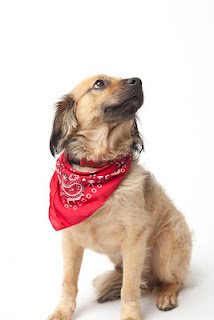 |
| My grand dog Tucker |
As an author and a reader I had to ask myself: Why is a book that includes animals richer, more entertaining, and more engaging than one without? The answer was simple: Animals bring out the best and the worst in a human character. This makes for great drama and provides an emotional touch point that is critical for an exciting read.
Max-the-Dog (his legal name) was originally created as a reflection of Josie, his mistress. Both had been abandoned, both had to fight for their lives, both were protective of others. But Max became so much more than Josie’s mirror as the series unfolded.
Here are four ways Max made a difference in the witness series:
HE ENHANCED HUMAN CHARACTERIZATION: Those who attack him were inherently more evil than a bad guy who ignored him. Those who love Max were more admirable because they cared for and protect him.
HE WAS AN ANIMATED SOUNDING BOARD: Internal dialogue can be tedious. Allow a character to speculate to an animal and the rhetorical questions or monologues sound natural.
HIS PRESENCE SET A TONE: A scene tone can be set by the way a human character speaks to or interacts with an animal counterpart. A whispered warning creates a much different tone than a screaming command; a languid pet conjures up different visions than a playful ruffling of fur.
HE HELPED MOVE THE PLOT FORWARD: An animal’s needs can put a human in a place they might not have been in. For instance, in Privileged Witness, Josie took Max out for his evening constitutional and ran into her fugitive client who was hiding outside. Without Max, Josie would have no reason to go outside and never would have discovered her client. An animal’s heightened senses can also assist a human to warn of danger or alert a human to a change in their surroundings.
From The Hound of the Baskervilles to Lassie and Blue Dog, My Friend Flicka and The Black Stallion, The Cheshire Cat and Puss-in-Boots, animals have frolicked as humans, served to reflect human frailties and strengths, and just plain worked their way into reader’s hearts because of who they are.
So, to the kind lady who was concerned about Max, have no fear. He will never come to a violent end. No matter what happens to him, his presence or lack thereof, will be a decision motivated by story and plot and, of course, love, because Max is as real to me as if he sat at my feet while I wrote my stories.
*Hostile Witness is free for all e-readers and is also available in print.
1 0 Read more
Featured Books
FAERY SWAP
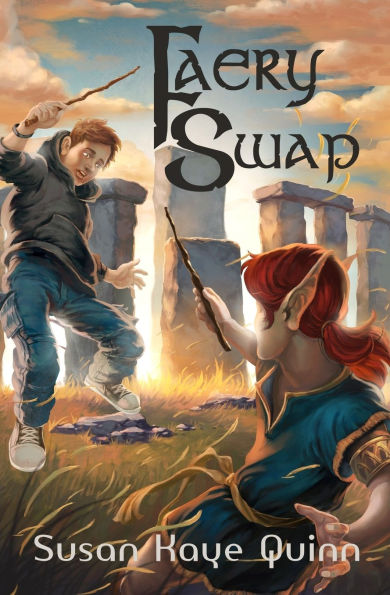
Warrior faery princes can be very stubborn. Especially when they possess your body.
More info →







LILIANA’S LETTER
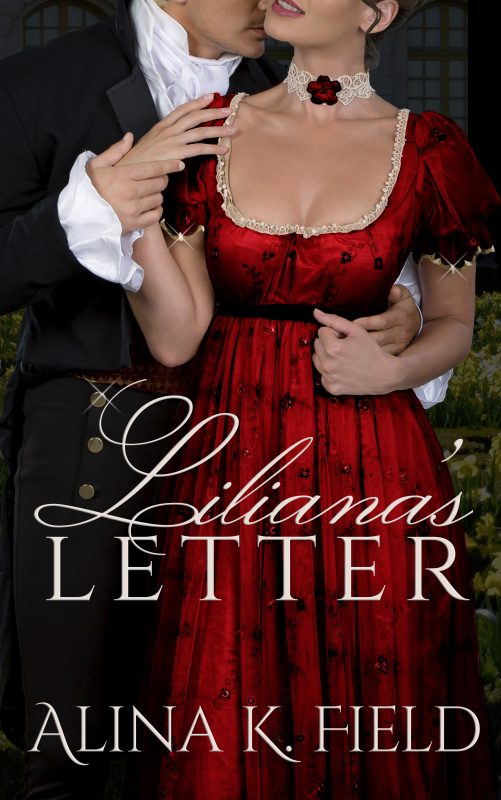
Hired to help an heiress snare a titled husband, a down-on-her-luck lady dodges her own shadowy past and the titled Lord determined to uncover it.
More info →